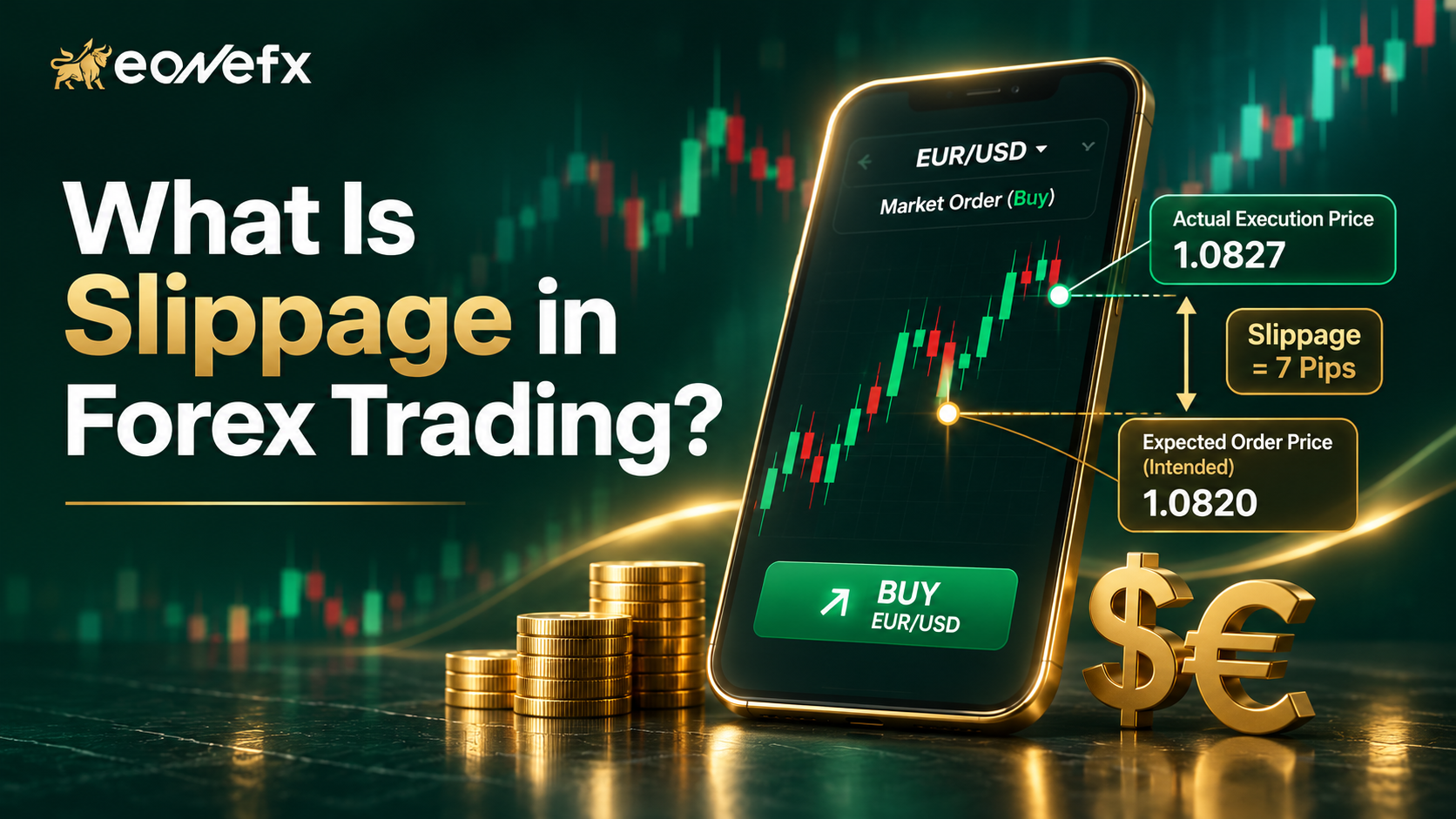
You click Buy at 1.0850. Your trade opens at 1.0853. Nothing is broken. You just met slippage in forex.
It confuses many beginners, so let us keep it simple. This guide explains the forex slippage meaning, the causes, real examples, and practical ways to manage it on MetaTrader 5.
What Is Slippage in Forex?
- Slippage is the difference between the price you expected and the price your order actually got filled at.
- It happens in fast or thin markets, when prices move before your order is executed.
- It can be negative (worse price), positive (better price) or zero.
- You cannot remove it fully, but you can reduce it.
Slippage in Forex Meaning: A Simple Definition
When you place a market order, you ask your broker to trade at the best available price right now. But prices change many times per second. By the time your order reaches the market, the price may have moved.
That gap between the requested price and the executed price is slippage in trading. It is a normal part of forex order execution, not a sign of a trick or a fault.
How Slippage Works
Think of it like booking a taxi in a busy city. The fare shown when you tap Book may change slightly by the time the driver arrives.
In forex, the steps are:
- You send an order.
- The order travels to the broker and then to liquidity providers.
- Prices update while this happens.
- The order fills at the next available price.
If liquidity is deep and the market is calm, the fill is usually the same or very close. If the market is rushing, the gap grows.
Positive and Negative Slippage
Negative slippage means you get a worse price than expected.
- Example: You buy EUR/USD at 1.0850 but get filled at 1.0853. That is 3 pips against you. On a 1 standard lot trade (about $10 per pip), that costs roughly $30.
Positive slippage means you get a better price.
- Example: You sell EUR/USD at 1.0850 but get filled at 1.0852. That is 2 pips in your favour, worth about $20 on 1 lot.
Slippage works both ways. Over many trades, it is part of your trading cost, so it deserves attention.
Main Causes of Slippage
- High volatility: Prices jump during economic releases such as US Non-Farm Payrolls or central bank decisions.
- Low liquidity: Fewer buyers and sellers during late sessions or on exotic pairs means bigger price gaps.
- Large order size: A big order may need to be filled in parts at different prices.
- Market gaps: Prices can open far from the previous close, especially after the weekend.
- Slow connection: A delay between your device and the server gives the price more time to move.
When Does Slippage Happen Most?
Watch out for these times:
- Major news events (interest rate decisions, inflation data, jobs reports)
- Market open on Monday
- Rollover time and very quiet Asian hours on some pairs
- Sudden risk events, such as political surprises
How to Check and Control Slippage on MT5
If you are following an MT5 tutorial or learning MetaTrader 5 for beginners, here is where slippage shows up on the MT5 trading platform:
- Open a new order with F9 (New Order).
- Look at the order type. Market execution fills at the best available price. Instant execution may let you set a Deviation (maximum price difference you accept).
- After the trade, open the History tab in the Toolbox.
- Compare your requested price with the Price column to see the fill.
A small deviation protects you from bad fills, but your order may be rejected if the price moves beyond it.
How to Avoid Slippage in Forex: 7 Practical Tips
- Avoid trading right during major news. Wait a few minutes until spreads and prices settle.
- Trade liquid pairs. EUR/USD, GBP/USD and USD/JPY usually fill more smoothly than exotics.
- Use limit orders when you want a fixed price. A limit order will not fill at a worse price, though it may not fill at all.
- Trade during busy sessions. The London and New York overlap has deep liquidity.
- Keep position sizes sensible. Smaller orders are easier to fill cleanly.
- Use a stable internet connection and consider a VPS if you run automated strategies.
- Choose a broker with fast, transparent execution and check its execution policy.
Benefits of Understanding Slippage
- You set more realistic profit and stop loss levels.
- You avoid panic when a fill is slightly different.
- You can include slippage in your trading costs and backtests.
- You stay calm during volatile sessions.
Risks to Keep in Mind
Slippage can also hit your stop loss. In very fast markets, a stop order becomes a market order once triggered, so it may fill beyond your stop price. That is why risk per trade should be small, so one bad fill does not hurt your account much.
Expert Tips
- Add a small slippage buffer (for example 1–2 pips) when you plan a trade.
- Test your strategy in demo first to see how fills behave.
- Keep a trading journal and note the requested price vs fill price. Patterns appear quickly.
Frequently Asked Questions
1. Is slippage in forex illegal or a scam?
No. Slippage is a normal market event caused by price movement between your click and the fill. It can be negative or positive. What matters is that your broker executes fairly and explains its execution policy openly.
2. Can slippage be avoided completely?
Not completely. You can reduce it by trading liquid pairs, avoiding major news, using limit orders and keeping a fast connection. Some slippage is simply part of how live markets work, so plan for it in your risk management.
3. What is the difference between slippage and spread?
Spread is the fixed or variable gap between the buy and sell price, charged on every trade. Slippage is the difference between your expected price and the executed price. Spread is predictable; slippage depends on market speed and liquidity.
4. Does slippage affect stop loss orders?
Yes. A stop loss becomes a market order when triggered, so in fast markets it can fill at a worse price than your stop level. This is called stop loss slippage. Using smaller position sizes helps limit the impact.
5. How do I see slippage on MT5?
Open the History tab in the MT5 Toolbox and compare the price you requested with the executed price. You can also set a Deviation value on instant execution orders to control the maximum price difference you accept.
Conclusion
Slippage in forex is not something to fear. It is a cost of trading that every trader faces. Once you understand the causes and use the tips above, you can trade with clearer expectations.
Ready to practise order execution safely? Open a demo account with eonefx, explore the MT5 platform and see how fills behave before you trade live.