• Client Login
site-logo
site-logo
  • ASSET CLASSES

    Currency CFDs Indices
    Commodities Precious Metals Oil, Energy & Metals

    eonefx trader

    Trade Options on financial markets.

    Learn More
    socialT
  • DETAILS

    Account Types Deposits / Withdrawals

    eonefx trader

    Trade Options on financial markets.

    Learn More
    socialT
  • DETAILS

    Trading Platform Economic Calendar Heatmap Analysis Calculators

    eonefx trader

    Trade Options on financial markets.

    Learn More
    socialT
  • DETAILS

    About Awards Regulation Liquidity
    Blog Legal Documents Contact

    eonefx trader

    Trade Options on financial markets.

    Learn More
    socialT
  • Partnership
  • Social Trading
  • Portfolio Management
  • Global English
  • Bahasa Indonesia
  • Malaysia English
  • Bahasa Melayu
Open Account
  1. Home
  2. Blog
  3. Standard vs Raw Spread Account: Which Is Better for Forex Trading?
forex education

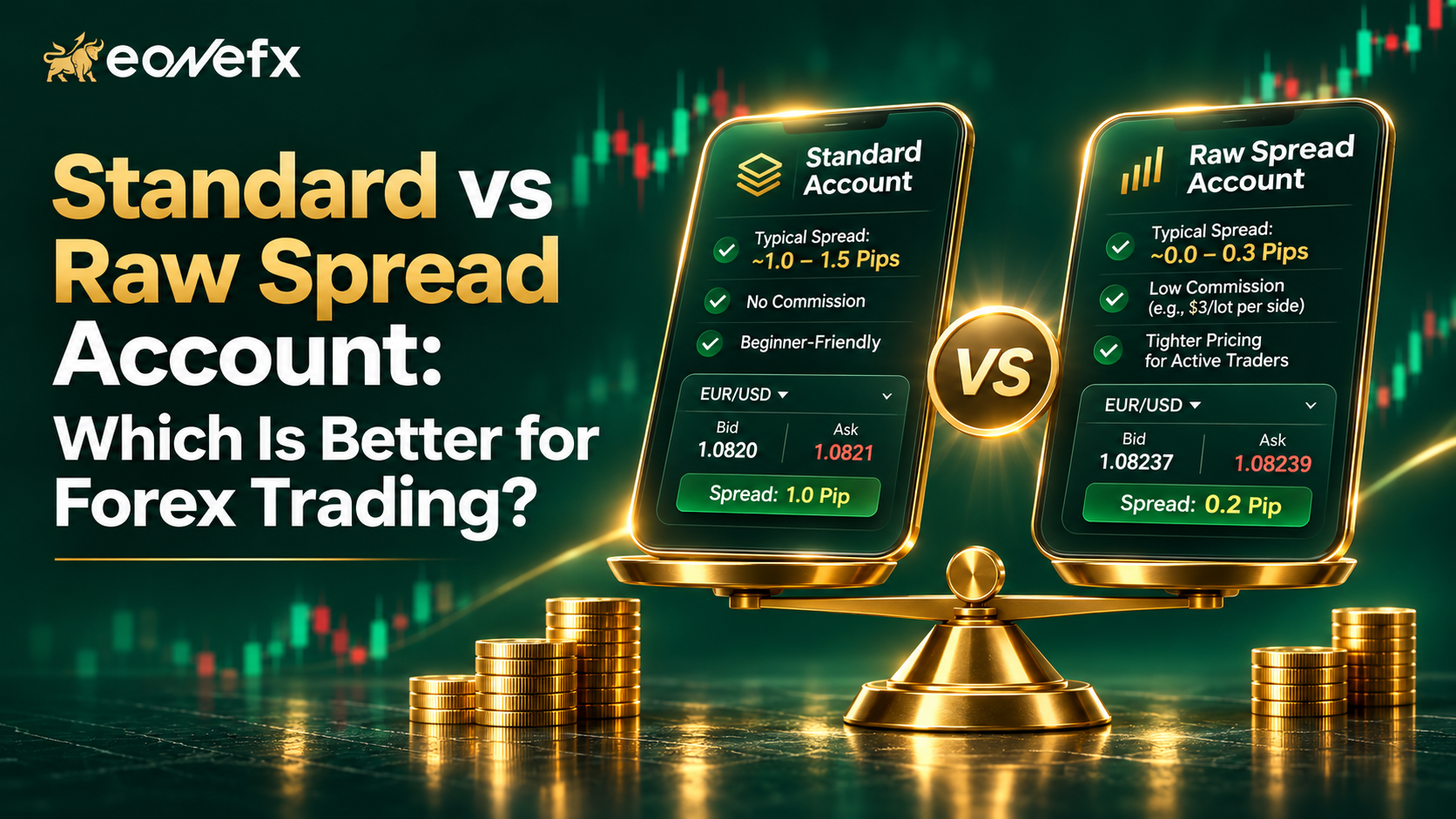
Standard vs Raw Spread Account: Which Is Better for Forex Trading?

By efx_admin • 22 October 2026 • 5 min read
Standard vs Raw Spread Account: Which Is Better for Forex Trading?

Choosing a trading account looks easy until you see two options: one with a wider spread and no commission, and another with a tiny spread and a commission. Which one is cheaper? The honest answer: it depends on how you trade.

This guide compares the standard vs raw spread account in simple language, with a cost example you can copy.

Standard vs Raw Spread Account

  • Standard account: Wider spread, usually no separate commission. Simple and beginner-friendly.
  • Raw spread account: Very tight spread, plus a commission per lot. Often better for active traders.
  • Total cost = spread cost + commission. Always compare the total, not just the spread.
  • Beginners who trade rarely can start with standard. Scalpers and high-volume traders often prefer raw.

What Is a Standard Forex Account?

A standard forex account builds the broker’s fee into the spread. The spread is the difference between the buy price and the sell price.

You see one clear cost per trade. There is usually no extra commission. This is why many people choose a standard forex account when they are starting out.

What Is a Raw Spread Account?

A raw spread account gives you spreads that are very close to the real market price, sometimes near 0.0 pips. The broker earns through a fixed forex trading commission per lot instead.

So the price looks cheaper on the chart, but you pay a small commission when you open and close a trade.

How Spreads and Commissions Work

  • Spread: The gap between bid and ask. You pay it the moment you open a trade.
  • Commission: A fixed fee per lot traded, often charged per side or as a round-turn total. Check which one your broker uses.
  • Pip value: On EUR/USD, 1 pip is about $10 per 1 standard lot.

Cost Example: Raw Spread vs Standard Account

The numbers below are illustrative only. Check the live spreads and commissions on your eonefx account page.

Standard account

  • Spread: 1.2 pips
  • Commission: $0
  • Cost per 1 lot: 1.2 × $10 = $12

Raw spread account

  • Spread: 0.1 pip → 0.1 × $10 = $1
  • Commission: $7 per lot round turn
  • Cost per 1 lot: $1 + $7 = $8

Difference: $4 saved per lot on raw. If you trade 10 lots a month, that is about $40. At 100 lots, that is $400.

But if you trade tiny sizes, like 0.01 lot, the difference is only a few cents, and the simplicity of standard may matter more.

Raw Spread vs Standard Account: Side-by-Side

  • Spread: Standard is wider; raw is tighter.
  • Commission: Standard usually none; raw has a per-lot fee.
  • Cost clarity: Standard is easier to read; raw needs a quick calculation.
  • Best for: Standard suits beginners and swing traders; raw suits scalpers, day traders and EA users.
  • Strategy fit: Short-term strategies with many trades benefit most from tight spreads.

Benefits of Each Account

Standard account benefits

  • Easy cost calculation
  • No commission to track
  • Good for learning

Raw spread account benefits

  • Tight spreads, especially during liquid sessions
  • Lower total cost for high-volume trading
  • Clear separation of spread and broker fee

Risks and Things to Watch

  • Raw accounts can show wider spreads during news or low liquidity, because spreads are variable.
  • Commissions add up if you over-trade.
  • A cheaper account does not make a losing strategy profitable. Risk management matters more than fees.

How to Choose the Best Forex Account Type: Step by Step

  1. Count your trades. How many lots do you trade per month?
  2. Check your style. Scalping and day trading favour raw. Long-term trading often fits standard.
  3. Calculate total cost. Use the formula: spread in pips × pip value + commission.
  4. Test on demo. Compare real spreads on both account types at the pairs you trade.
  5. Start small. Move to the other account type if your trading volume changes.

Expert Tips

  • Compare costs on your main pair, not just EUR/USD.
  • Check spreads at your normal trading hours.
  • Review your monthly costs every quarter. Your best account today may change as you grow.

Frequently Asked Questions

1. Is a raw spread account better than a standard account? 

Not always. Raw accounts usually cost less for active traders who place many orders, because the spread is tiny. Standard accounts are simpler and can be just as good for beginners or occasional traders. Compare the total cost.

2. Do raw spread accounts charge commission? 

Yes. A raw spread account typically charges a commission per lot, in return for much tighter spreads. The commission may be charged per side or as a round-turn fee, so always check the exact structure before opening a live account.

3. Which account is best for beginners? 

Many beginners start with a standard account because costs are built into the spread and are easy to understand. Start on a demo account, learn the basics, and then decide whether a raw account suits your trading volume.

4. Which account type is best for scalping? 

Scalpers usually prefer raw spread accounts because tight spreads reduce cost on frequent, short trades. Always add the commission to your calculation, and make sure your broker allows your strategy and offers fast order execution.

5. Can I switch from standard to raw later? 

Most brokers let you open an additional account type or move between them. Policies differ, so check with eonefx support for the current process. Many traders test both types on demo before committing.

Conclusion

The best forex account type is the one that matches your habits. Trade rarely and want simplicity? Standard is a great start. Trade often and want lower total cost? Look closely at raw spread.

Ready to explore the markets?

Open an account when you are ready and access the EoneFX trading experience.

Open Account
efx_admin

About the author

efx_admin

Dive into EoneFX Insights, your ultimate hub for expert market analysis, trading tips, and industry updates. From forex strategies to platform guidance, this blog equips traders with the tools and insights they need to succeed in dynamic markets. Stay informed and elevate your trading game with actionable content tailored for both beginners and professionals.

Table of Contents

  1. Standard vs Raw Spread Account
    1. What Is a Standard Forex Account?
      1. What Is a Raw Spread Account?
        1. How Spreads and Commissions Work
          1. Cost Example: Raw Spread vs Standard Account
        2. Raw Spread vs Standard Account: Side-by-Side
          1. Benefits of Each Account
        3. Risks and Things to Watch
          1. How to Choose the Best Forex Account Type: Step by Step
            1. Expert Tips
          2. Frequently Asked Questions
            1. Conclusion

              Recent Blogs

              How to Backtest a Forex Trading Strategy How to Backtest a Forex Trading Strategy on MetaTrader 5 29 Oct 2026 What Is a Margin Call in Forex Trading What Is a Margin Call in Forex Trading? Examples and… 15 Oct 2026 What Is Slippage in Forex Trading What Is Slippage in Forex Trading? Causes, Examples and How… 08 Oct 2026 stop-loss-vs-take-profit-2560 What Is the Difference Between Stop-Loss and Take-Profit Orders? A… 20 Aug 2026

              Share this article

              Facebook Facebook LinkedIn LinkedIn WhatsApp WhatsApp X X Email Email
              Support Infrastructure Access Help Center
              site-logo
              pm
              pm
              pm
              pm
              pm
              Accounts
              • Deposit And Withdrawal
              • Account Types
              Partnership
              • Affilate Program
              Markets
              • Currency
              • Commodities
              • Metals
              • Indices
              • CFD
              Tools
              • Trading Platform
              • Economic Calendar
              • Heatmap Analysis
              • Calculators
              Company
              • About Us
              • Awards
              • Regulation
              • Blog
              • Legal Documents
              • Contact Us
              Our Policy
              • Privacy Policy
              • Terms and Conditions
              • Risk Discloser
              • Conflicts of Interest Disclosure
              • Deposit & Withdrawal Policy
              • Relationship Disclosure
              • Restricted Countries
              • Terms Of Use
              site-icon

              Eonefx

              Trade Multipliers and Accumulator Options on our mobile app.

              site-icon

              Scan to download


              Copyright © 2026 – All rights reserved.

              Legal: Company Name: EONE CAPITAL LIMITED. Regulator: Financial Services Commission (FSC), Mauritius. License Type: SEC-2.1B Investment Dealer (Full Service Dealer excluding Underwriting). License Date: 10 January 2024. Status: Company is Incorporated. Registered Office: 4th Floor, The Docks, Caudan, Port Louis, Mauritius. Official FSC Register: View Register.

              Risk Warning: CFDs are complex instruments and come with a high risk of losing money rapidly due to leverage. Between 80% of retail investor accounts lose money when trading CFDs with this provider. You should consider whether you understand how CFDs work and whether you can afford to take the high risk of losing your money.

              Disclaimer : The content provided on this website is for informational purposes only. It is not intended to serve as financial advice, nor should it be interpreted as such. CFD trading and other financial instruments are speculative in nature and involve a high level of risk. You should seek independent advice from a qualified financial professional to ensure that you fully understand the risks associated with trading before making any investment decisions.

              You should carefully consider whether trading is appropriate for you based on your personal circumstances, including your financial resources, investment experience, and risk tolerance.

              By trading, you acknowledge and accept that you may lose some or all of the funds you invest. Therefore, only trade with capital that you can afford to lose. Past performance is not indicative of future results, and there is no guarantee that you will make profits.

              Your capital is risk. Leveraged products may not be suitable for everyone. Please consider our Risk Disclosure.

              Restricted Regions: EONE Capital Limited does not provide services for citizens/residents of the United States, Russia, Cuba, Iraq, India, Myanmar, North Korea, Sudan. The services of EONE Capital Limited are not intended for distribution to, or use by, any person in any country or jurisdiction where such distribution or use would be contrary to local law or regulation.

              Register today and avail the benefits today

              Open Account site-icon Need Assistance?
              Need Assistance?
              Kerala promotion
              Goa promotion
              Dubai promotion
              Malaysia promotion